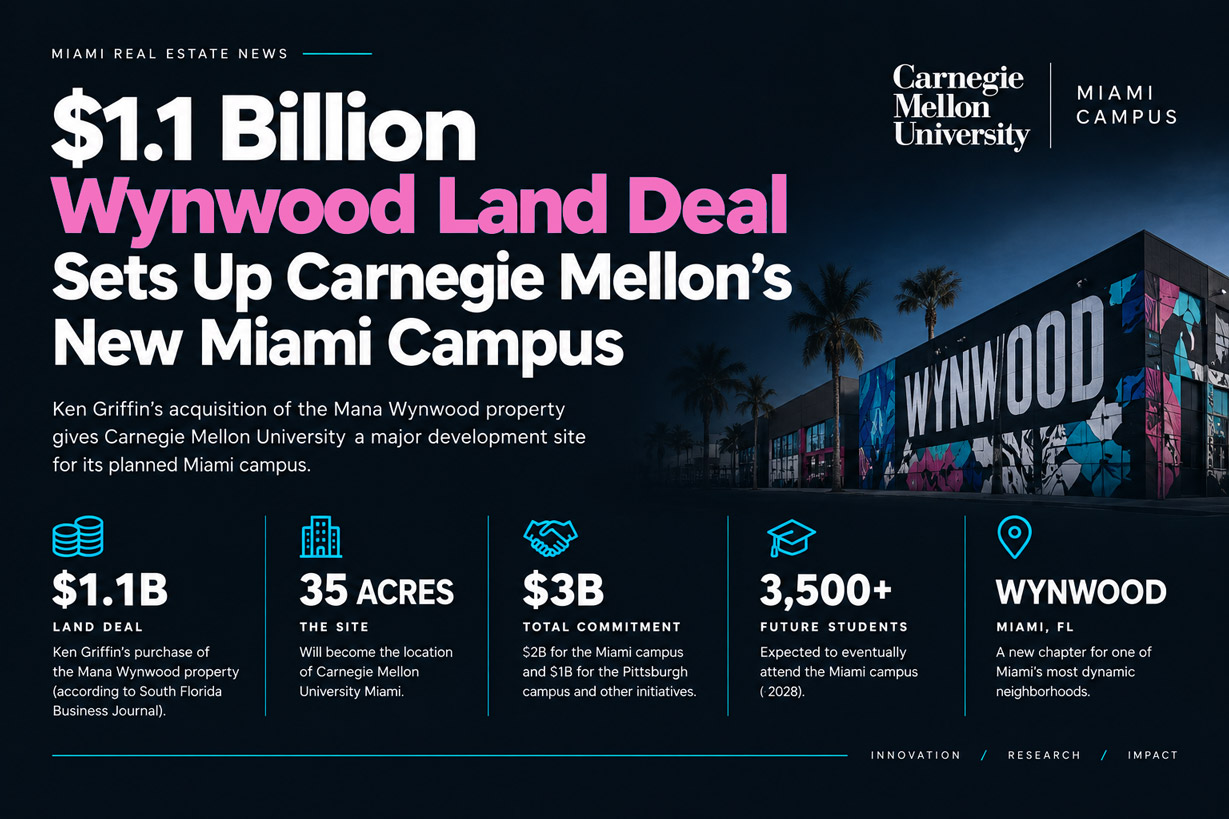
Ken Griffin’s acquisition of the Mana Wynwood property gives Carnegie Mellon University a major development site for its planned Miami campus.
A major Wynwood property transaction has become the real estate foundation for Carnegie Mellon University’s planned Miami expansion.
Moishe Mana confirmed on September 30 that he sold the Wynwood property to Ken Griffin for approximately $1.1 billion, according to the South Florida Business Journal. The publication described the transaction as the most expensive land deal ever in South Florida.
The property is expected to become the site of Carnegie Mellon University Miami, a planned 35-acre campus backed by Griffin’s historic $3 billion gift to the university.
What Was Sold?
The transaction involves the Mana Wynwood complex, a large property in the Wynwood district that has been associated with Miami’s arts, entertainment and commercial redevelopment.
The Real Deal reported that Griffin’s purchase of the complex closed on September 30 after negotiations that had been underway for more than a year.
The property will now have a substantially different long-term role as Carnegie Mellon develops its Miami campus.
How the Land Deal Connects to Carnegie Mellon
The land purchase is part of the larger plan announced by Carnegie Mellon and Griffin.
Griffin committed $3 billion to Carnegie Mellon, with approximately $2 billion directed toward establishing the Miami campus. The remaining $1 billion supports the university’s Pittsburgh campus and other initiatives.
This distinction matters because the $1.1 billion property transaction and the $2 billion Miami commitment are not identical figures or separate $1 billion investments into the same asset.
The $1.1 billion represents the reported property purchase, while the $2 billion figure refers to the broader funding commitment for the Miami campus.
Why This Is Significant for Wynwood
Wynwood has undergone significant redevelopment over the past several years, with residential, hospitality, office, retail and cultural projects changing the neighborhood.
The arrival of a major research university introduces another type of institutional presence.
Carnegie Mellon says its Miami campus will focus on human health and biological discovery, national security and strategic capabilities, advanced manufacturing and industrial transformation, and energy and climate resilience.
The campus will also emphasize artificial intelligence, robotics, machine learning, autonomy and other emerging technologies.
What Could Surround the Campus?
The long-term effects on surrounding development remain to be seen.
A large university campus can create demand for housing, restaurants, retail, transportation, professional services and other businesses, but the actual scale and timing of those effects will depend on construction, enrollment, campus operations and future development decisions.
For Wynwood, future reporting should therefore focus on measurable changes rather than assumptions.
That includes:
- Construction activity
- New businesses
- Residential development
- Commercial leasing
- Transportation changes
- Employment
- Student housing
- University partnerships
- Nearby property transactions
Carnegie Mellon’s Expected Timeline
Carnegie Mellon has said construction is expected to begin in 2027, with the first students expected in 2028, subject to regulatory approvals. The campus is projected to eventually accommodate more than 3,500 students.
That makes the Wynwood property one of the most important pieces of Miami’s emerging university and technology landscape.
What Happens Next?
The next major milestones will be related to campus planning, approvals, design, construction and the development of academic and research programs.
For Miami residents and businesses, the most important developments to watch will be how the campus integrates with Wynwood and how nearby development responds to the new institutional anchor.
Sources
South Florida Business Journal
The Real Deal
Carnegie Mellon University
Associated Press