
Look across Miami’s skyline today, and one thing becomes immediately obvious.
Luxury condominium towers are everywhere.
From Brickell and Downtown Miami to Edgewater, Sunny Isles Beach, Surfside, and Miami Beach, new residential towers continue rising at a remarkable pace. Some are among the tallest buildings ever constructed in Florida. Others are setting records for sales prices, amenities, and architectural design.
For many residents, investors, and visitors, the question is simple:
Why are so many luxury condos being built in Miami?
The answer goes far beyond real estate speculation.
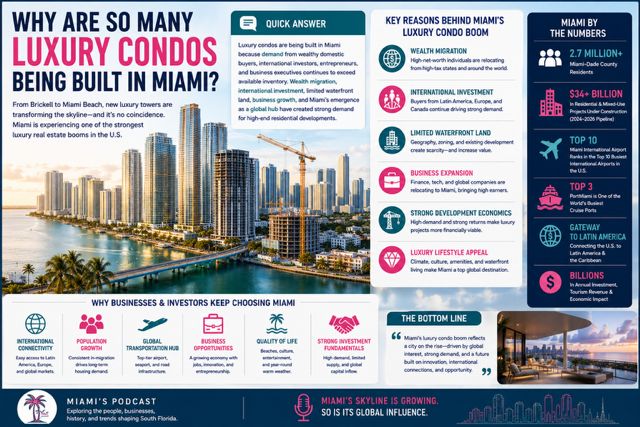
Miami’s luxury condo boom is being driven by wealth migration, international investment, population growth, limited waterfront land, business expansion, and the city’s emergence as one of the world’s leading destinations for affluent individuals and global capital.
Miami is experiencing a luxury condo construction boom because demand from affluent buyers, investors, entrepreneurs, business executives, and second-home owners continues to exceed available inventory in many premium neighborhoods. Wealth migration, international investment, limited waterfront land, business growth, and Miami’s emergence as a global financial and technology hub have created strong demand for high-end residential developments across South Florida.
Many people assume Miami’s luxury development boom began during the pandemic.
In reality, the foundation was built decades earlier.
South Florida has long attracted affluent buyers from Latin America, Europe, Canada, and the Northeastern United States.
However, several major trends accelerated demand dramatically after 2020.
These include:
Miami’s luxury condo market became the intersection of all these trends.
Today, developers are responding to a demand surge that has been building for years.
One of the most important factors behind Miami’s condo boom is wealth migration.
Florida has consistently ranked among the top destinations for high-net-worth individuals relocating within the United States.
Many affluent households have moved from states including:
For some buyers, taxes play a role.
For others, quality of life is the primary motivation.
Many are seeking:
Miami offers all of those advantages in one location.
As wealthy individuals relocate, demand for luxury housing naturally follows.
Miami has long been one of the most international cities in the United States.
Unlike many luxury real estate markets that depend primarily on domestic buyers, Miami attracts capital from around the world.
Buyers frequently come from:
Many view Miami real estate as both a lifestyle purchase and a long-term investment.
The city’s role as the Gateway to Latin America continues strengthening these international relationships.
For many international buyers, Miami offers something unique: access to the U.S. market combined with a global culture and strong connections to Latin America and Europe.
One factor often overlooked in discussions about Miami real estate is geography.
Miami simply does not have unlimited waterfront land.
The Atlantic Ocean sits to the east.
Biscayne Bay occupies much of the urban waterfront.
Protected areas, existing neighborhoods, infrastructure, and zoning restrictions limit where large-scale development can occur.
As demand rises and developable land becomes scarcer, luxury projects become increasingly attractive from a financial standpoint.
Developers are often competing for some of the most desirable waterfront property in North America.
This scarcity helps explain why so many new projects target the luxury market.
This is one of the most frequently asked questions about Miami real estate.
The answer largely comes down to economics.
Construction costs have increased substantially in recent years.
Developers face expenses related to:
Luxury developments often generate higher returns that help offset these costs.
As a result, many developers focus on projects where demand is strongest and profit margins are highest.
This dynamic has become one of the most debated issues in Miami’s housing market.
Another major trend driving construction is the growth of branded residences.
Luxury brands have increasingly entered the residential development market.
Examples include residences associated with:
These developments often offer:
The success of branded residences has encouraged additional luxury development throughout South Florida.
Real estate is not growing in isolation.
Miami’s business environment has changed dramatically.
Over the past several years, South Florida has attracted:
As high-income professionals relocate to Miami, demand for premium housing increases.
Luxury residential development often follows business growth.
In many ways, Miami’s condo boom reflects the city’s broader economic transformation.
One of the biggest shifts in Miami real estate is the growing demand for luxury residential space compared to traditional office development.
While office demand remains healthy in certain areas, developers often find that luxury condominiums generate stronger returns on valuable waterfront and urban land.
Many buyers are willing to pay significant premiums for:
This helps explain why many of Miami’s most visible development projects are residential towers rather than office buildings.
Few American cities currently have as many high-profile residential towers under development as Miami.
Projects such as:
Represent billions of dollars in combined investment.
Many of these projects sold substantial portions of their inventory before construction was completed.
That level of demand helps explain why additional luxury developments continue entering the market.
Several trends help explain Miami’s luxury condo growth:
Together, these factors create an environment that continues supporting high-end residential development.
This debate continues among economists, developers, investors, and residents.
Some believe development levels could eventually outpace demand.
Others argue that Miami’s population growth, wealth migration, international investment, and business expansion will continue supporting new projects.
Historically, Miami has experienced periods of rapid growth followed by market adjustments.
The key difference today is the diversity of demand.
Miami has experienced multiple real estate booms throughout its history.
What makes the current cycle different is the variety of buyers entering the market.
Previous cycles often relied heavily on speculative investment.
Today’s buyers include:
Because demand is coming from multiple sources, many analysts believe Miami’s luxury market is supported by stronger long-term fundamentals than some previous cycles.
Luxury condominiums are likely to remain a major part of Miami’s development story.
The city continues attracting investment, talent, businesses, and international attention.
As long as Miami remains a destination for wealth, entrepreneurship, tourism, and global commerce, demand for premium housing is expected to remain strong.
The skyline will continue changing.
New towers will continue rising.
And luxury residential development will remain one of the most visible signs of Miami’s transformation into a global city.
So why are so many luxury condos being built in Miami?
Because Miami sits at the intersection of several powerful trends.
Population growth.
International investment.
Business migration.
Limited waterfront land.
Global wealth movement.
And a growing reputation as one of the world’s most desirable places to live, work, and invest.
The luxury towers rising across Miami’s skyline are more than real estate projects.
They are visible evidence of Miami’s continuing evolution into one of the most influential cities in the Americas.
Luxury condos are being built because demand from wealthy domestic buyers, international investors, entrepreneurs, and business executives continues supporting new development throughout South Florida.
Buyers include local residents, business owners, retirees, remote workers, second-home buyers, international investors, and high-net-worth individuals relocating from other states and countries.
Many affluent individuals are drawn to Miami because of its climate, waterfront lifestyle, business opportunities, international connectivity, cultural diversity, and growing economy.
Branded residences are luxury condominium developments associated with well-known hospitality and luxury brands such as Waldorf Astoria, Bentley, Porsche, Ritz-Carlton, St. Regis, and Mercedes-Benz.
Developable waterfront land is limited due to geography, existing development, zoning restrictions, and environmental considerations, which contributes to the value of premium properties.
Luxury developments generate construction jobs, property tax revenue, business activity, tourism spending, and significant investment throughout the local economy.
Developers continue investing heavily because population growth, international demand, wealth migration, business expansion, and limited waterfront land have helped support strong demand for luxury residential properties.
Some of the most active areas include Brickell, Downtown Miami, Edgewater, Sunny Isles Beach, Surfside, Miami Beach, and neighborhoods surrounding Biscayne Bay.
Many analysts believe continued population growth, international investment, business expansion, and wealth migration will support long-term demand, although real estate markets can experience cycles over time.
For inquiries, sponsorship opportunities, or to share your Miami business story, contact us


