
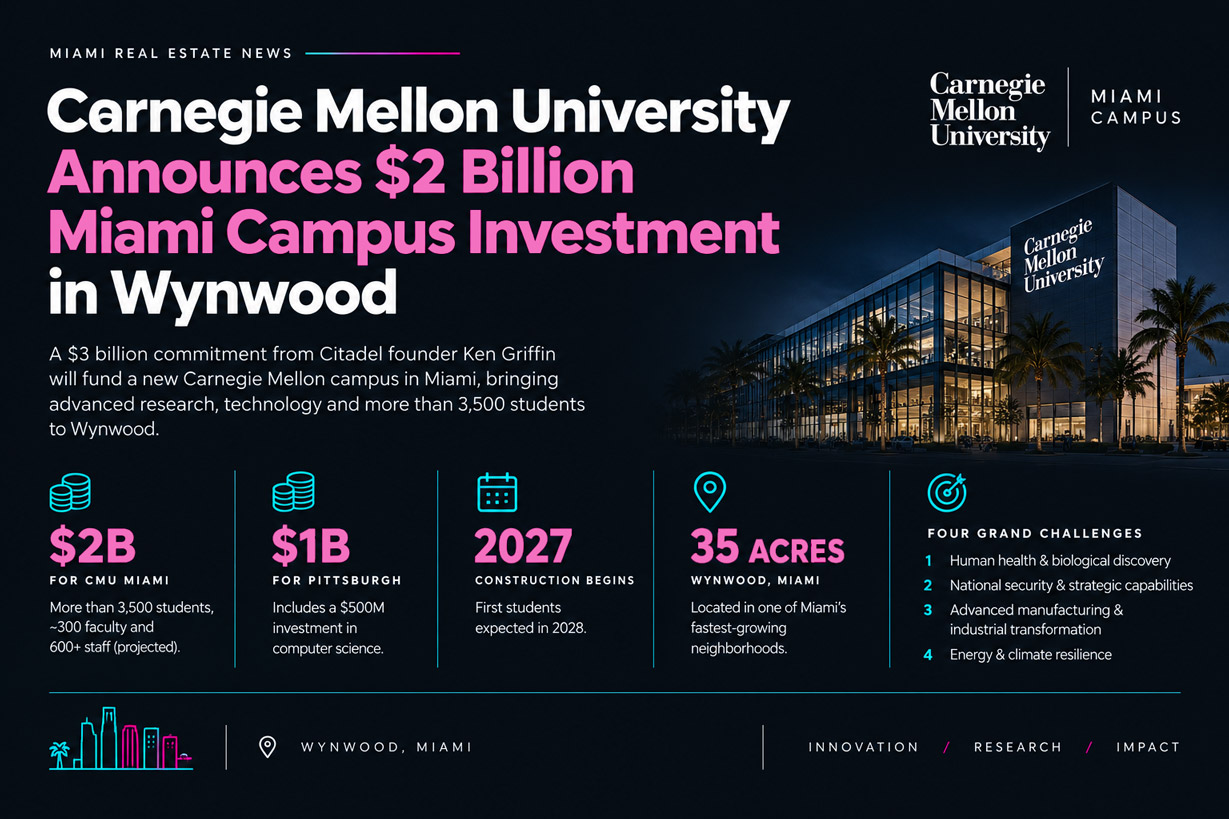
A $3 billion commitment from Citadel founder Ken Griffin will fund a new Carnegie Mellon campus in Miami, bringing advanced research, technology and more than 3,500 students to Wynwood.
Miami is set to receive one of the largest new institutional investments in its education and technology ecosystem after Carnegie Mellon University announced a new Miami campus backed by a $3 billion commitment from Citadel founder and CEO Ken Griffin.
Of the total commitment, $2 billion will support the creation of Carnegie Mellon University Miami, while the remaining $1 billion will support Carnegie Mellon’s Pittsburgh campus, including a $500 million investment in computer science.
The new campus will be built on approximately 35 acres in Miami’s Wynwood neighborhood. Carnegie Mellon expects construction to begin in 2027, with the first students expected to enroll in 2028. The university projects that the campus will eventually support more than 3,500 undergraduate, master’s and doctoral students, along with nearly 300 faculty members and more than 600 staff.
The announcement places a major new education and research institution in one of Miami’s most rapidly changing neighborhoods.
The Miami portion represents the majority of Griffin’s $3 billion commitment.
Carnegie Mellon says the new campus will be designed around interdisciplinary research and education rather than a traditional structure built primarily around academic departments and majors.
The university plans to organize CMU Miami around four initial grand challenge areas:
Artificial intelligence and other emerging technologies will be incorporated across these areas.
That approach means the campus is being designed not simply as another university location, but as a place where researchers, students, companies and other partners can work together around large-scale technological and societal challenges.
The new campus will be located in Wynwood, north of downtown Miami.
The neighborhood has undergone a major transformation over the past decade, evolving from an industrial area into a major center for art, restaurants, offices, retail, hospitality and residential development.
The Carnegie Mellon project adds a large institutional and educational use to that mix.
The site is associated with the Mana Wynwood property. The South Florida Business Journal reported September 30 that the site was sold to Griffin for $1.1 billion, describing the transaction as the most expensive land deal in South Florida.
The university’s campus will therefore become part of a neighborhood already attracting substantial private investment and redevelopment.
Carnegie Mellon says CMU Miami will organize its academic and research activities around problems that cross traditional academic disciplines.
Researchers and students will work across areas involving biology, engineering, computation and related fields.
The university says the goal is to bring multiple disciplines together to address complex health and scientific challenges.
Another focus will be technology and research connected to national security and strategic capabilities.
The university has identified this as one of its initial challenge areas rather than creating a standalone academic major around it.
CMU Miami will also focus on manufacturing and industrial technologies.
This connects with Carnegie Mellon’s longstanding work in robotics, computer science and engineering and its broader emphasis on technology-driven innovation.
The fourth initial focus area will address energy and climate resilience.
For Miami, that topic has a particularly local connection because South Florida faces challenges involving coastal conditions, extreme weather, infrastructure and long-term climate resilience.
The university says these challenges will require collaboration across engineering, energy systems, building design, finance and other fields.
The Miami campus is expected to place significant emphasis on artificial intelligence and emerging technology.
Carnegie Mellon has a long history in computer science, artificial intelligence, robotics and machine learning. The university says the new Miami campus will use those capabilities across its challenge areas.
The institution’s separate $500 million investment in computer science will also provide additional resources for computing infrastructure, including GPUs, servers, storage and networking capabilities.
That investment is part of the broader $1 billion allocated to Carnegie Mellon’s Pittsburgh campus.
Carnegie Mellon expects the new campus to eventually support more than 3,500 students across undergraduate, master’s and doctoral programs.
The campus is also projected to include approximately 300 faculty members and more than 600 staff members.
The first students are expected in 2028, while construction is scheduled to begin in 2027, subject to the required approvals and development process.
A major research university can connect education, research, entrepreneurs, investors and established companies.
Carnegie Mellon has particular strengths in areas such as artificial intelligence, robotics, computer science and advanced technology. Bringing those capabilities to Miami creates potential opportunities for collaboration between the university and the region’s existing technology ecosystem.
The university says CMU Miami will work with government and industry partners around its challenge areas.
The campus could therefore become relevant not only to students but also to Miami startups, technology companies, researchers and businesses looking for talent and research partnerships.
The exact economic impact on Miami, however, will depend on how the campus develops, the partnerships it establishes and the businesses and research activity that emerge around it.
The location is significant.
Wynwood has already attracted major development and investment in residential, commercial, hospitality and mixed-use projects.
The addition of a large university campus introduces a different type of long-term land use: an institutional presence designed to operate for decades.
The site is expected to become a major part of the neighborhood’s next phase of development.
Rather than simply adding another office or residential project, CMU Miami will bring students, faculty, researchers and university operations into the neighborhood.
Carnegie Mellon’s arrival adds another major institution to a region that already includes University of Miami, Florida International University and Miami Dade College.
The three institutions collectively serve a large student population and already contribute to South Florida’s education, research and workforce ecosystem.
Carnegie Mellon also already has connections to Florida.
Its computer science programs have participated in AI education initiatives in Florida, while the university has worked with the Gates Foundation and Miami Dade College on AI-supported educational materials.
The new campus expands those existing connections into a permanent Miami presence.
Carnegie Mellon plans to begin construction of the Miami campus in 2027.
The university expects the first students to arrive in 2028, with the campus ultimately expanding to more than 3,500 students.
Before then, the project will move through its development and construction phases, while Carnegie Mellon works on the academic programs, research infrastructure, faculty recruitment and partnerships that will support the new campus.
The university’s four initial challenge areas will also shape how CMU Miami builds relationships with government, industry and research organizations.
The Carnegie Mellon announcement represents a significant new flow of capital into Miami’s education, research and technology infrastructure.
The $2 billion allocation for the Miami campus will support a large physical development in Wynwood, while the university’s planned programs could bring thousands of students, hundreds of faculty members and a substantial staff operation to the area.
For Miami’s broader investment landscape, the project also illustrates how capital is moving beyond traditional real estate and into education, technology, research and innovation infrastructure.
The long-term results will take years to develop, but the September 30 announcement establishes a major new institutional project in Miami with construction expected to begin next year.
$2 billion of Ken Griffin's total $3 billion commitment to Carnegie Mellon is designated for the new Miami campus.
The campus will be located on approximately 35 acres in Wynwood, Miami.
Construction is scheduled to begin in 2027.
Carnegie Mellon expects the Miami campus to begin enrolling students in 2028.
The university expects the campus to eventually support more than 3,500 undergraduate, master's and doctoral students.
CMU Miami will initially organize its programs and research around four challenge areas: human health and biological discovery; national security and strategic capabilities; advanced manufacturing and industrial transformation; and energy and climate resilience.
Know a Miami investment, development or business story worth covering? Nominate it for Miami’s Podcast.
For inquiries, sponsorship opportunities, or to share your Miami business story, contact us


