
If you’ve ever visited South Florida, you’ve probably heard Miami referred to as “The Magic City.”
The nickname appears everywhere. Local businesses use it. Residents say it with pride. Tourists hear it constantly. Yet many people still ask the same question:
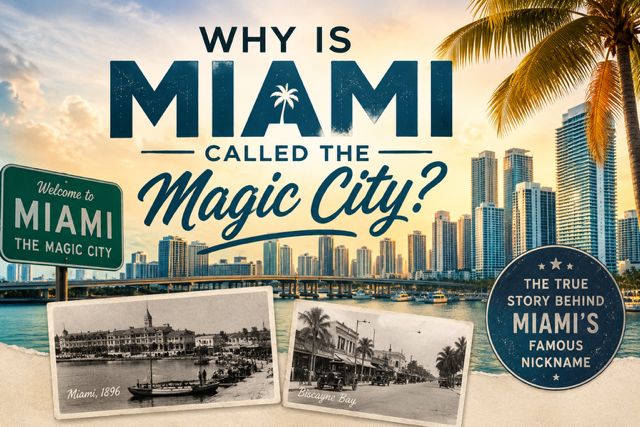
Why is Miami called the Magic City?
The answer is rooted in one of the most remarkable growth stories in American history.
Unlike many city nicknames that were created through marketing campaigns, Miami earned its nickname naturally because of the astonishing speed at which it grew after becoming a city.
Miami is called the Magic City because it grew so quickly after its incorporation on July 28, 1896, that visitors often returned to find entirely new neighborhoods, hotels, businesses, and streets. The city’s rapid transformation seemed almost magical, leading residents and visitors to nickname it “The Magic City.”
More than a century later, the nickname remains one of the most recognized symbols of Miami’s identity.
Miami officially became a city on July 28, 1896.
At the time of incorporation, the city had approximately 300 residents.
What happened next surprised nearly everyone.
Within just a few years, Miami began expanding at an extraordinary pace. New businesses opened regularly. Hotels appeared throughout the area. Residential neighborhoods expanded. Rail connections brought new residents, investors, and tourists from across the country.
People who returned to Miami after only a short absence often found a city that looked dramatically different from the one they had previously visited.
The growth seemed almost impossible.
As a result, locals and visitors began referring to Miami as “The Magic City.”
There is no single person credited with creating the nickname.
Unlike many modern city slogans, “The Magic City” emerged organically from the people witnessing Miami’s transformation.
Residents, developers, visitors, and newspaper writers frequently described Miami’s growth as magical because new buildings, businesses, and communities seemed to appear overnight.
Over time, the phrase became permanently associated with the city.
Today, more than 125 years later, the nickname remains widely used throughout South Florida.
Several factors contributed to Miami’s rapid development.
The most important was transportation.
Before the arrival of the railroad, South Florida remained relatively isolated from much of the United States. Travel was difficult, and economic opportunities were limited.
That changed when railroad developer Henry Flagler extended the Florida East Coast Railway to Miami.
The railroad connected Miami to larger markets, making it easier for people, goods, and investment capital to reach South Florida.
Combined with Miami’s tropical climate and strategic location, the city suddenly became a destination for growth.
Henry Flagler is often considered one of the most influential figures in Miami’s history.
By extending his Florida East Coast Railway to Miami in 1896, Flagler helped transform the region from a small settlement into a growing city.
His investments in transportation and hospitality encouraged tourism, business development, and migration to South Florida.
Without the railroad, Miami’s growth likely would have looked very different.
Many historians consider Flagler’s railroad expansion one of the most important events in Miami’s development.
Julia Tuttle is often known as the “Mother of Miami.”
She played a critical role in convincing Henry Flagler to extend his railroad farther south.
During the devastating Great Freeze of 1894–1895, much of Florida’s citrus industry suffered severe damage. Miami’s tropical climate largely protected the area from the freeze.
Recognizing the opportunity, Tuttle persuaded Flagler that South Florida had enormous potential for growth.
Her efforts ultimately helped bring the railroad to Miami and contributed directly to the city’s incorporation in 1896.
Today, she remains one of the most important figures in Miami’s history.
Miami’s growth story becomes even more impressive when viewed through historical facts:
These numbers help explain why many people still believe the nickname “Magic City” accurately describes Miami today.
Yes.
More than a century after the nickname first appeared, Miami is still widely known as the Magic City.
Many residents believe the nickname remains relevant because Miami continues evolving at a remarkable pace.
New residential towers reshape the skyline. New businesses continue opening. International investment flows into South Florida. Entrepreneurs, remote workers, and major corporations continue relocating to the region.
Just as visitors were amazed by Miami’s transformation in the early 1900s, many people today are witnessing another period of rapid growth.
Miami’s nickname is more than a historical reference.
It represents a city that has consistently reinvented itself.
From a small frontier settlement to a major international destination, Miami has repeatedly exceeded expectations.
Today, the city serves as a center for tourism, technology, finance, healthcare, logistics, real estate, international trade, and entrepreneurship.
Its influence extends far beyond South Florida.
For many residents, investors, and business owners, Miami continues to feel like a city where extraordinary things happen.
So why is Miami called the Magic City?
Because few cities in American history have experienced growth as dramatic as Miami’s.
After its incorporation in 1896, the city expanded so rapidly that people described the transformation as magical. Entire neighborhoods, hotels, businesses, and streets seemed to appear almost overnight.
The nickname stuck.
More than 125 years later, Miami remains one of the most dynamic and recognizable cities in the United States.
And for many who watch the city continue to grow, the name still feels well deserved.
Miami is called the Magic City because it grew extraordinarily fast after its incorporation in 1896. Visitors often returned to find entirely new neighborhoods, businesses, and buildings that had not existed during their previous visit.
The nickname emerged in the years following Miami’s incorporation in 1896 as residents and visitors witnessed the city’s rapid growth and development.
Miami was officially incorporated on July 28, 1896. Julia Tuttle played a major role in the city’s creation and is often called the “Mother of Miami.”
Henry Flagler extended the Florida East Coast Railway to Miami, helping connect the city to the rest of the country and fueling its early growth.
Yes. The nickname remains widely used by residents, businesses, media outlets, and visitors throughout South Florida.
Miami benefited from railroad access, a warm climate, tourism, international trade opportunities, and continued investment, all of which helped accelerate its growth.
At the time of incorporation in 1896, Miami had approximately 300 residents.
The Great Freeze of 1894–1895 damaged crops across much of Florida but largely spared Miami. This helped convince Henry Flagler to extend his railroad to South Florida.
Julia Tuttle helped persuade Henry Flagler to bring his railroad to Miami, a decision that played a major role in the city’s development and incorporation.
Many people believe it does. Miami continues experiencing significant growth in population, business development, tourism, real estate, and international investment, much like it did during its earliest years.
For inquiries, sponsorship opportunities, or to share your Miami business story, contact us


