


If you’ve ever heard Miami referred to as the “Gateway to Latin America,” you may have wondered where that nickname comes from.
The phrase is commonly used by business leaders, economists, investors, airlines, trade organizations, and government officials throughout the Americas. It reflects Miami’s unique position as one of the most important connections between the United States, Latin America, and the Caribbean.
Today, Miami serves as a major center for international trade, finance, transportation, tourism, business development, and cultural exchange. Its strategic location, global transportation infrastructure, and deep ties to Latin American countries have helped transform the city into one of the most internationally connected metropolitan areas in the world.
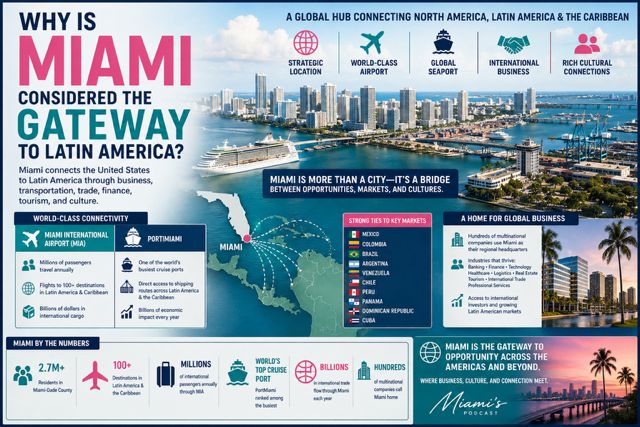
Miami is considered the Gateway to Latin America because it serves as one of the primary business, transportation, financial, and cultural links between the United States and Latin America. Home to Miami International Airport, PortMiami, and hundreds of multinational regional headquarters, Miami plays a central role in trade, tourism, investment, and international commerce throughout the Western Hemisphere. Its geographic location and strong economic relationships with Latin American countries have made it one of the most influential global cities in the Americas.
Geography plays a major role in Miami’s international importance.
Located at the southeastern tip of Florida, Miami sits closer to many Latin American and Caribbean cities than it does to parts of the western United States. This strategic position has helped make the city a natural hub for transportation, international trade, tourism, and business expansion.
For companies looking to operate throughout Latin America, Miami offers convenient access to major markets while providing the benefits of conducting business within the United States.
Its location continues to be one of the biggest reasons why Miami has become a leading international business hub.
Miami’s rise as an international city accelerated throughout the twentieth century.
As commercial aviation expanded and international trade increased, Miami emerged as a critical connection point between North America, Latin America, and the Caribbean. Political, economic, and demographic changes throughout the region further strengthened the city’s role as a gateway for commerce and migration.
Business owners, investors, entrepreneurs, and families from across Latin America established strong ties to South Florida. Over time, these relationships created a powerful network of economic and cultural connections that continue to shape Miami today.
Countries with particularly strong ties to Miami include:
Mexico
Colombia
Brazil
Argentina
Venezuela
Chile
Peru
Panama
Dominican Republic
Cuba
These relationships have helped transform Miami into one of the most globally connected cities in the Western Hemisphere.
The term “Gateway to Latin America” is widely used by multinational corporations, logistics companies, trade organizations, economists, investors, and government agencies.
For decades, companies have used Miami as a regional base for managing operations throughout Latin America. The city’s transportation infrastructure, multilingual workforce, business-friendly environment, and international connectivity make it an attractive location for organizations serving multiple countries across the region.
The phrase continues to be used because Miami remains one of the most important entry points for commerce, investment, tourism, and cultural exchange between the United States and Latin America.
One of the biggest reasons Miami is considered the Gateway to Latin America is Miami International Airport.
The airport serves as one of the busiest international gateways in the United States and provides extensive flight connections throughout Latin America, the Caribbean, Europe, and North America.
Millions of travelers pass through Miami each year while billions of dollars in international cargo move through the airport. For many passengers traveling between the United States and Latin America, Miami serves as the primary connection point.
The airport’s global reach helps support tourism, trade, international business, and economic growth throughout South Florida.
Miami’s international influence extends beyond air travel.
PortMiami is one of the most important seaports in the United States and serves both commercial shipping and the global cruise industry. The port provides direct access to shipping routes throughout Latin America, the Caribbean, and international markets around the world.
Its strategic location allows businesses to move goods efficiently between regions while supporting billions of dollars in economic activity.
PortMiami’s role in global logistics and trade further strengthens Miami’s reputation as a major transportation hub.
Many multinational companies use Miami as a headquarters or regional office for Latin American operations.
Rather than maintaining separate offices in every country throughout the region, businesses often centralize operations in South Florida and coordinate activities across multiple markets from a single location.
Industries that frequently use Miami as a regional hub include:
Banking
Finance
Technology
Healthcare
Logistics
Real estate
Tourism
International trade
Professional services
This concentration of international business activity has helped make Miami one of America’s most globally connected cities.
Businesses choose Miami because it provides direct access to Latin American markets while allowing companies to operate within the legal, financial, and business framework of the United States.
Advantages often include:
Extensive international flight connections
A multilingual workforce
Strong banking and financial services
Established trade and logistics infrastructure
Access to international investors
Proximity to major Latin American markets
Diverse talent pools
These advantages continue to attract companies involved in international business, trade, finance, healthcare, technology, and real estate.
Miami’s relationship with Latin America goes far beyond business.
The city’s culture has been shaped by generations of immigrants from across Latin America and the Caribbean. Spanish is widely spoken throughout Miami-Dade County, and influences from countries across the region can be seen in local food, music, art, architecture, and community traditions.
Visitors often describe Miami as a cultural bridge between North America and Latin America because of the diversity and international character that define the city.
This cultural connection remains one of the strongest reasons the nickname continues to resonate today.
Miami’s role as the Gateway to Latin America can be seen through several key indicators:
Miami-Dade County is home to more than 2.7 million residents.
Miami International Airport ranks among the busiest international airports in the United States.
Millions of passengers travel through Miami annually on routes connecting North America, Latin America, Europe, and the Caribbean.
PortMiami is consistently recognized as one of the world’s busiest cruise ports.
Hundreds of multinational companies maintain offices or regional headquarters in South Florida.
International trade supports billions of dollars in economic activity each year.
Miami remains one of the leading financial centers focused on Latin American markets.
Together, these factors help explain why Miami continues to play such an important role in global commerce and transportation.
Miami’s international influence impacts much more than tourism.
The city’s position as a gateway supports:
Economic growth
Job creation
International investment
Trade opportunities
Business expansion
Tourism development
Cultural exchange
Many of the industries helping Miami grow today exist because of the city’s strong relationships with Latin America and the Caribbean.
Without those connections, Miami would likely look very different economically, culturally, and internationally.
Several cities around the world serve as important international gateways, but Miami occupies a unique position when it comes to Latin America.
Cities such as New York, Houston, Panama City, and Madrid maintain strong connections to the region. However, few cities combine Miami’s geographic location, transportation infrastructure, cultural ties, and concentration of Latin American business activity.
For many companies, investors, and travelers, Miami remains the most practical entry point into Latin American markets while also providing access to the broader United States economy.
Absolutely.
Despite changes in technology, transportation, and global business practices, Miami remains one of the most important international cities in the Western Hemisphere.
Companies continue opening regional offices.
Investors continue choosing South Florida.
International travelers continue passing through the city.
Trade continues flowing through Miami International Airport and PortMiami.
More than ever, Miami serves as a bridge connecting North America, Latin America, and the Caribbean.
So why is Miami considered the Gateway to Latin America?
Because few cities are as deeply connected to the region through transportation, business, finance, culture, tourism, and international trade.
For more than a century, Miami has evolved from a growing coastal city into one of the world’s most important international hubs. Its role as the Gateway to Latin America is built on geography, transportation infrastructure, economic relationships, and cultural connections that continue to shape the region today.
Whether viewed through the lens of commerce, tourism, investment, or culture, Miami remains one of the most influential cities connecting the United States, Latin America, and the Caribbean.
As international business and global trade continue to expand, Miami’s importance as a gateway city is likely to grow even further.
Miami is called the Gateway to Latin America because it serves as a major center for trade, transportation, tourism, finance, business, and cultural exchange between the United States and Latin American countries.
Miami's geographic location, international airport, seaport, business community, and cultural connections make it one of the most important cities linking North America with Latin America.
Many companies use Miami as a regional headquarters because it provides access to Latin American markets while offering the advantages of operating within the United States.
Miami International Airport serves as a major connection point for passengers and cargo traveling between North America, Latin America, Europe, and the Caribbean.
PortMiami helps facilitate international commerce by connecting shipping routes throughout Latin America, the Caribbean, and global markets.
While Miami is located in the United States, many multinational corporations use the city as their Latin American headquarters, making it one of the region's most influential business centers.
Miami maintains strong business and cultural relationships with countries including Mexico, Brazil, Colombia, Argentina, Chile, Peru, Panama, the Dominican Republic, Venezuela, and Cuba.
Investors are attracted to Miami because of its international connectivity, growing economy, strong real estate market, diverse population, and access to Latin American business opportunities.
Many experts consider Miami one of the most international cities in both Florida and the United States due to its global business presence, diverse population, and transportation infrastructure.
Miami's relationship with Latin America supports economic growth, job creation, tourism, international investment, business development, and cultural exchange throughout South Florida.
For inquiries, sponsorship opportunities, or to share your Miami business story, contact us


