Long before Miami became known for luxury condos, palm-lined beaches, nightlife, and global business influence, it was considered by many to be little more than untamed wilderness.
In the late 1800s, South Florida was largely undeveloped. Dense swampland, difficult terrain, mosquitoes, and isolation kept most investors and developers away. There were no major highways, no skyline, and most importantly—no railroad connection.
At the time, few people believed a major city could ever thrive this far south in Florida.
But one woman saw something different.
Her name was Julia Tuttle.
And one strategic decision she made would help shape the future of an entire city.
Miami Before the Boom
To understand the significance of Julia Tuttle’s story, you first have to understand what Miami looked like before it became “Miami.”
In the 1890s, South Florida was isolated from much of the state. Most economic development in Florida was happening farther north. Railroads had expanded through parts of the state, but the southern tip of Florida remained disconnected and difficult to access.
Transportation was one of the biggest obstacles.
Without a railroad:
Businesses struggled to move goods
Tourism was nearly impossible at scale
Agricultural growth was limited
Population growth remained slow
At the center of Florida’s railroad expansion was one of the most influential businessmen in American history:
Henry Flagler.
Flagler, co-founder of Standard Oil alongside John D. Rockefeller, had already transformed parts of Florida through the expansion of his Florida East Coast Railway. His railroad developments helped fuel growth in cities like St. Augustine and Palm Beach.
But extending the railroad farther south into what would eventually become Miami was considered risky.
Many believed there simply wasn’t enough opportunity there to justify the investment.
The Freeze That Changed Everything
Then came one of the most important events in Florida’s agricultural history: the Great Freeze of 1894–1895.
Severe cold weather devastated crops across much of the state. Orange groves and agricultural operations were destroyed in many northern and central Florida regions.
But something unusual happened in South Florida.
Miami remained largely unaffected.
While much of Florida froze, the Miami area continued producing crops and growing citrus.
To Julia Tuttle, this was more than weather—it was proof.
Proof that Miami possessed unique economic potential.
Proof that South Florida could become one of the most valuable agricultural and development regions in the state.
And she knew exactly who needed to see it.
The Orange Blossoms That Helped Build a City
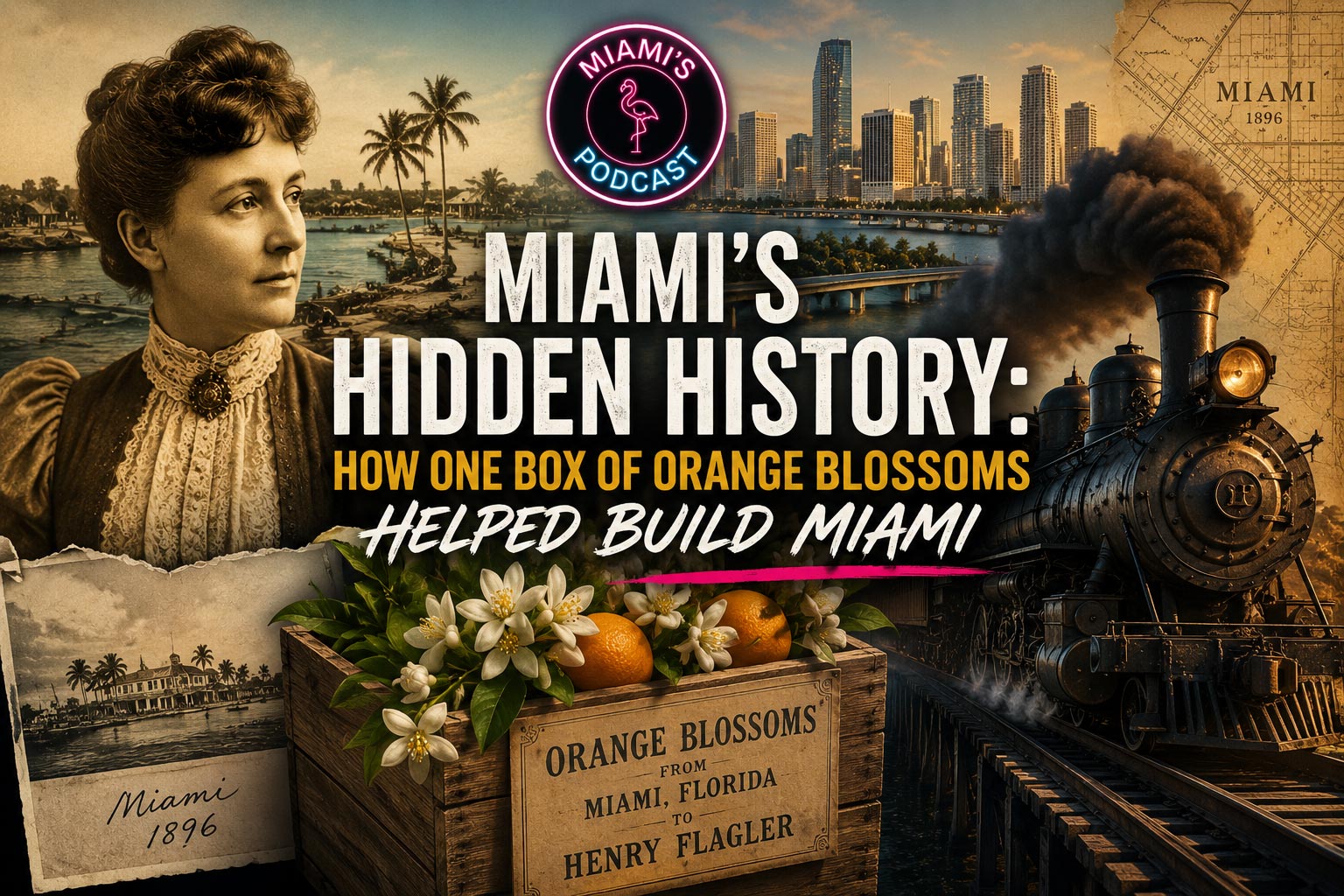
According to historical accounts, Julia Tuttle gathered fresh orange blossoms and sent them to Henry Flagler.
At a time when much of Florida’s citrus industry had been destroyed by freezing temperatures, those blossoms represented something powerful:
Opportunity.
The gesture wasn’t random.
It was strategic persuasion.
Tuttle understood that seeing living orange blossoms during a devastating freeze would immediately demonstrate Miami’s climate advantage and long-term economic value.
And it worked.
The evidence reportedly helped convince Flagler to extend his railroad farther south.
That single decision would permanently alter the future of Miami.
The Railroad That Created Modern Miami
Once Flagler committed to bringing the railroad south, development accelerated rapidly.
The railroad:
Connected Miami to the rest of Florida
Increased migration and investment
Opened tourism opportunities
Expanded trade and agriculture
Attracted developers, entrepreneurs, and settlers
In many ways, the railroad became the foundation of modern Miami.
On July 28, 1896, the City of Miami was officially incorporated.
Its population at incorporation was just over 300 people.
Today, the Miami metropolitan area is home to millions and serves as one of the most globally recognized cities in the world.
What was once viewed as swampland became:
An international business hub
A global tourism destination
A major center for finance and real estate
One of America’s fastest-growing metropolitan areas
And much of that growth traces back to one critical moment of vision and persuasion.
Why Julia Tuttle’s Story Still Matters Today
Julia Tuttle is often referred to as the “Mother of Miami.”
And for good reason.
Her story is not simply about railroads or orange blossoms.
It’s about recognizing opportunity before everyone else does.
While others saw:
Isolation
Swampland
Risk
Distance
She saw:
Climate advantages
Economic opportunity
Long-term growth potential
The future of a city
Perhaps most importantly, she understood something many entrepreneurs still overlook today:
Vision alone is not enough.
You must also know how to communicate that vision to the right people.
Her decision to send those orange blossoms wasn’t accidental—it was strategic.
She presented evidence in a way that made opportunity impossible to ignore.
How One Decision Helped Shape Miami’s Future
Looking back today, it’s difficult to imagine Miami without:
Brickell
Wynwood
Miami Beach
Luxury real estate developments
International business influence
Millions of annual visitors
But none of that growth was guaranteed.
Cities are often shaped by a handful of key moments.
And one of Miami’s most important moments began with a woman who believed in a city before the rest of the world did.
Miami’s Hidden History — Part 1
This story is part of Miami’s Hidden History, a series from Miami’s Podcast uncovering the untold business, cultural, and historical stories that helped shape the Magic City.
Because behind every skyline…
There’s a story most people never hear.
Final Thought
One strategic decision.
One persuasive act.
One vision for the future.
That’s all it took to help change the course of Miami forever.
And today, more than a century later, the impact of Julia Tuttle’s vision can still be seen across the entire city.